Finalrentals Blog

Published in Guides Category.
Leaving Dubai by road is easier than many visitors expect. When you rent a car in the UAE, you can travel between emirates without routine border checks. In fact, driving from Dubai to other emirates can be as simple as making a longer journey within one city.
However, speed enforcement, toll charges, and parking rules can change along the way. You'll also need to know what your rental agreement covers before travelling further. Our guide explains the differences, the main driving routes, and what to check before setting off.
Driving Rules That Change When Leaving Dubai
The same basic traffic laws apply throughout the country. However, watch for local rules and charges once you cross into another emirate.
Crossing Emirate Borders Without Checkpoints
You can normally drive between all seven emirates without passing through immigration or customs. Travelling from Dubai to Sharjah or Abu Dhabi is not the same as crossing into Oman. Police may conduct checks when needed, but there are no routine passport controls on the main inter-emirate roads.
Keep your full driving licence and identification with you. Carry an International Driving Permit or certified translation if your rental terms require one. Follow any local signs or temporary traffic restrictions as soon as you reach them. Route numbers are useful even when road names change across emirate boundaries.
Speed Limits and Traffic Enforcement Across Emirates
Speed cameras are the biggest difference to understand when driving from Dubai to other emirates. On many Dubai roads, cameras are set above the posted limit, often by 20 kilometres per hour. However, the posted speed remains the limit you should follow. Never treat a camera setting as permission to drive faster.
Abu Dhabi has no such camera buffer. A radar can record a violation as soon as you exceed the signed limit. A section of E311 near Baniyas has a posted speed limit of 100 kilometres per hour, reduced from 120 kilometres per hour. The limit applies in both directions between Tawi Al Qaymah Street and Al Khayr Street.
Watch electronic signs during fog, heavy rain, or dust. Abu Dhabi can reduce speed limits temporarily, including to 80 kilometres per hour, when visibility is poor. Leave more space between cars and slow down before entering affected stretches. Automated fines can arrive after you have left the emirate.
Dubai Salik and Abu Dhabi Darb Toll Systems

Two different systems manage the main UAE toll roads. Dubai uses Salik tags, while Abu Dhabi's Darb system recognises number plates. Neither requires you to stop at a tollbooth.
Dubai's Salik usually charges AED 6 per crossing from 6:00 A.M. to 10:00 A.M. and 4:00 P.M. to 8:00 P.M., Monday to Saturday. Off-peak crossings cost AED 4, and crossings are free overnight from 1:00 A.M. to 6:00 A.M. Sundays generally cost AED 4 outside the overnight period. Special event, public holiday, and Ramadan schedules may differ.
In Abu Dhabi, four bridge gates charge AED 4 per crossing from 7:00 A.M. to 9:00 A.M. and 3:00 P.M. to 7:00 P.M., Monday to Saturday. Those bridge crossings are free on Sundays and public holidays. However, the Ghantoot and Al Qurm gates charge AED 4 around the clock. You may therefore pay a Darb toll when driving from Dubai to Abu Dhabi, even outside peak hours.
Sharjah, Ajman, Fujairah, and Umm Al Quwain have no comparable general toll network. Ras Al Khaimah also has a more limited electronic toll system called Aber. Your rental company normally bills recorded crossings later, sometimes with an administration fee. Ask how your car's toll registration and payments are arranged before departure.
Parking Rules and Payment Methods Outside Dubai
When driving across the UAE, parking is another area where local rules matter. In Abu Dhabi, public parking uses two main colour-coded categories. Premium bays have white and turquoise markings and cost AED 3 per hour, with a 4-hour maximum. Standard bays have black and turquoise markings and cost AED 2 per hour or AED 15 per day.
Abu Dhabi's public paid hours run from 8:00 A.M. to midnight, with free parking on Sundays and public holidays. However, spaces marked for residents have extra overnight restrictions. Pay through the available parking machines or approved payment services, and check your bay's markings carefully.
In Sharjah, paid parking generally runs from 8:00 A.M. to midnight. Standard yellow-sign areas are free on Fridays and public holidays, while blue-sign zones charge daily.
Do not rely on the rules from the previous city. Check the sign beside your parking space, confirm your payment, and return before the paid session expires. Parking violations can lead to fines billed through your rental company.
Driving Routes from Dubai to the Other Six Emirates
When driving from Dubai to other emirates, choose your route based on traffic, road type, and your planned stops.
Dubai to Abu Dhabi: Major Highways and Travel Times
The usual route is Sheik Zayed Road (E11) to Abu Dhabi. E311 offers another choice if you start from inland Dubai. Central Dubai and central Abu Dhabi are about 140 kilometres apart. A typical journey takes 1 hour 30 minutes to 2 hours. Busy city entrances can extend the drive.
Yas Island is nearer the Dubai side of Abu Dhabi, while Saadiyat Island and the Corniche require more driving. Watch motorway exits carefully, since both roads have several major interchanges. Avoid the busiest commuting periods when possible.
For a longer day out, you can continue towards Al Ain or visit desert attractions outside the centre. Choose the correct exit for your destination rather than assuming every Abu Dhabi attraction uses the same approach road.
Dubai to Sharjah and Ajman: Traffic and Road Access
Sharjah lies immediately north of Dubai, with Ajman just beyond it. E11 runs through built-up districts, while E311 and E611 offer routes further inland. Central Dubai to central Sharjah is roughly 25 to 35 kilometres, but commuter traffic can be heavy near the boundary.
Expect around 30 minutes in light traffic for nearby areas, with much longer journeys possible at rush hour. Weekday mornings are often busy towards Dubai, while evening traffic builds in the other direction. Travelling to Ajman usually adds another 10 to 20 minutes after Sharjah, depending on your route.
If you're driving from Dubai to other emirates for short day trips, start outside the busiest commuting hours. E611 can help you avoid central Sharjah when you're heading to Ajman.
Dubai to Umm Al Quwain and Ras Al Khaimah: Northern Routes
For the northern emirates, E11 follows the coastal corridor, while E311 and E611 serve more inland journeys. Umm Al Quwain is around 60 to 80 kilometres from Dubai, often about 1 hour away in light traffic. Ras Al Khaimah city is roughly 100 to 120 kilometres away. The drive usually takes 1 hour 15 minutes to 1 hour 45 minutes.
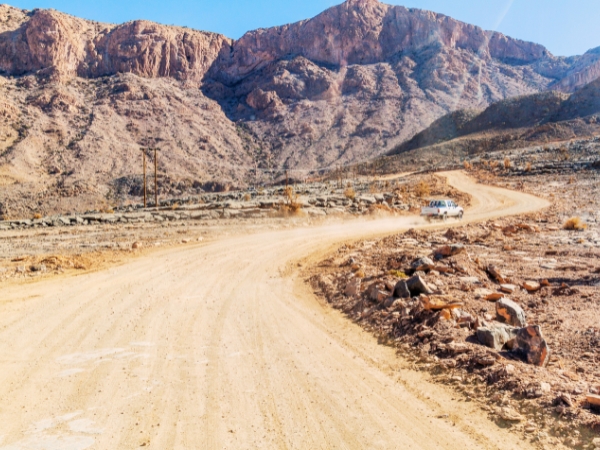
The roads are generally wide and paved, with fewer built-up sections farther north. Jebel Jais lies beyond Ras Al Khaimah city and needs extra driving time. A standard car can use the paved route in suitable weather, while an SUV offers more passenger space.
Dubai to Fujairah: Mountain Roads and Coastal Access
Fujairah is on the east coast, beyond the Hajar Mountains. The main route is E84 (Sheik Khalifa bin Zayed Road), reached via inland connections such as E611. Another option heads towards Masafi on E88 before continuing towards Fujairah. You can also head to Kalba via E102, though the route may take longer.

The journey covers about 120 to 135 kilometres. Expect 1 hour 30 minutes to 2 hours, depending on traffic. Unlike the main Abu Dhabi motorway, the mountain sections have bends, gradients, and tunnels. Slow down before descents and adjust your speed if rain or dust reduces visibility.
On eastern routes, plan your fuel stop before entering the mountains. Stations are easier to find in the larger towns than along some mountain stretches. The main highways are paved, so you can drive a standard rental car on them. Unpaved wadis and mountain tracks are a separate matter and may fall outside your rental cover.
Renting a Car in Dubai for Travel to Other Emirates
A Dubai pickup can cover several destinations, but rental conditions still affect your plans. Before leaving Dubai, check the agreement for permitted routes and any charges after your return.
Rental Agreement, Insurance Coverage, and Road Restrictions
Most car rental companies permit travel between the seven emirates, but confirm the policy in writing. Driving between emirates is different from crossing an international border. With Final Rentals, you can drive throughout the UAE, but you cannot take your rental car into another country or on a ferry.
Included protection can reduce your financial responsibility, but an excess still applies to covered claims. Damage or theft also requires a police report and prompt notice to the rental desk. Glass, tyres, undercarriage damage, personal items, and certain other losses are excluded. Avoid unpaved routes unless your booking clearly covers them.
For a trip beyond Dubai, book a car rental with Final Rentals and compare available SUVs or smaller cars. The booking includes collision damage waiver, theft waiver, and third-party liability cover, subject to the stated excess and exclusions.
Renters must be 25 to 75 years old and have at least 1 year of driving experience. You also need a full driving licence. Bring your passport or valid identification and any required licence translation or International Driving Permit.
Mileage Limits, Fuel Costs, and Additional Rental Charges
When driving from Dubai to other emirates, you can cover more distance than expected, especially on a return trip. Final Rentals allows 250 kilometres per day for daily and weekly bookings. Extra distance costs more. Monthly bookings have a separate allowance. Estimate your full return journey, not only the one-way drive.
Fuel stations are easy to find on major intercity roads, but fill up before longer desert or mountain stretches. Keep the car's fuel level close to its pickup level. You must return it with the same amount, or a refuelling charge may apply.
Tolls, traffic fines, parking penalties, and additional administration fees can appear after the trip. A different return location can also carry a separate one-way fee. If you are comparing car hire costs in the UAE, look beyond the daily rate. Include the driving distance and likely charges in your plans.
Returning a Rental Car Outside Dubai
If you plan to finish in Abu Dhabi or another emirate, arrange one-way drop-off in advance. Not every branch accepts returns from another city. Your confirmed booking should state the permitted location and any extra fee. Final Rentals allows one-way returns outside Dubai, with an additional charge depending on your drop-off location.
Confirm the return time as carefully as the address. Under these terms, you have a 1-hour late-return grace period before you are charged for another day. Returning early does not earn a refund for unused rental days.
Before handing back the keys, inspect the car and take photos of its condition and fuel gauge. Remove your belongings, keep your return receipt, and check for tolls or fines later.
Takeaway
One detail worth remembering when driving from Dubai to other emirates is how far apart motorway exits can be. Missing the correct turn on E11, E311, or E611 may mean driving several more kilometres before you can change direction safely. Move into the correct lane early when your exit approaches, but avoid sudden lane changes. If you miss it, continue until your navigation finds another legal route.
Rent a car in the UAE with Final Rentals to enjoy breakdown assistance for covered issues during longer drives. Airport pick-ups and drop-offs are also available 24/7. Book and manage your car rental anytime. Download the Final Rentals app on Google Play and the App Store.
Frequently Asked Questions
How long does driving from Dubai to Abu Dhabi take?
The journey from central Dubai to central Abu Dhabi is about 140 kilometres. In normal traffic, expect 1 hour 30 minutes to 2 hours, though busy periods may add time. E11 is the main route, with E311 as another option. Remember that the newer Ghantoot Darb gate charges throughout the day, including outside the usual peak hours.
Do I need toll tags to drive between emirates?
Your rental car should already have the correct toll setup, but confirm how they bill charges. Dubai uses Salik tags, while Abu Dhabi's Darb system reads number plates. Most Darb bridge gates charge during set hours, but Ghantoot and Al Qurm charge all day. Ras Al Khaimah also has a limited toll system, so ask about any planned crossings.
What should I know before taking a UAE road trip?
A UAE road trip can take you between cities, coastal towns, and mountain areas without routine border checks. Follow the signed speed limits and remember that Abu Dhabi has no camera buffer. Check local parking rules, plan fuel stops, and confirm your rental's mileage limit before leaving. For longer routes, check weather conditions and leave enough time for the return drive.